The length your body draws.
is the single most useful idea in Kibbe once the / framework clicks. It's the line your frame draws from head to toe — not your actual height — and it's what clothing either extends or interrupts.
Height by Kibbe type
Each image identity lands in a typical height range, sorted below from petite to tall. Use it as a sanity check, not a verdict — perceived line still beats inches, but extreme outliers (e.g. a 5'2" Flamboyant Natural) are rare.
What Kibbe actually cares about is how tall you read — your , the impression your frame gives off, not the number on the measuring tape. A 5'4" Dramatic can read tall. A 5'10" Soft Natural can read relaxed and earthy.
Romantic
RHeight read · Petite to moderate — typically 5'5" and under. The frame stays consistently small.
Soft and flowing silhouettes that showcase the lush curves of your body. Waist definition is essential, always, with lots of gentle draping everywhere. Avoid all severe silhouettes, all tailored silhouettes, all straight lines with sharp angular edges, and all vertical lines that hide the waist.
What lengthens and what shortens the line
Four axes shape the read — your limbs, your frame, your flesh, and your styling. On each axis, one quality stretches the line upward into a vertical read; the other interrupts it sideways into a horizontal read. Neither side is better — they just produce different lines.
Limb length relative to torso stretches the line. Long limbs on a short torso can visually elongate a petite frame.
Short arms and legs on a long torso create a compact, gathered read — yin territory even if the bones are sharp.
Narrow shoulders read straight down. Sharp edges give the eye a crisp top to the line.
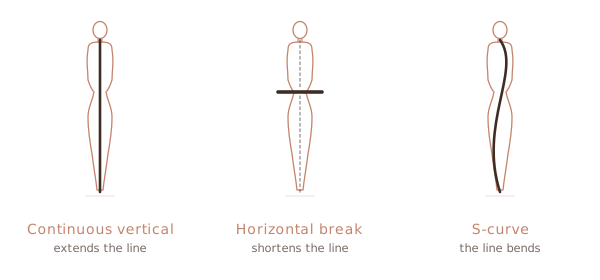
When hips and bust pull outward, the eye moves side-to-side. The line becomes an S, not a stroke.
Less padding between skin and bone lets the vertical read cleanly. Not about being thin — about how flesh sits on the frame.
Rounded flesh breaks up a clean vertical. Neutral information — the line just reads lush instead of long.
One color head-to-toe, long hemlines, vertical seams continue the line.
Any hard horizontal stop — a belt, a cropped jacket, color-blocking at the waist — visually shortens the line.
The styling takeaway isn't that long vertical is better. It's that your body is already drawing a line, and your clothes can continue it or interrupt it.
I may earn a commission through some affiliate links in this module. Please consider using them — they keep the core StyleMeMama tools free and help cover ongoing costs.