The frame underneath the line.
If is the stroke your body makes from head to toe, is the hand drawing it. The architecture under the — shoulders, wrists, jaw, ribcage — sets the shape your clothes have to honor, and it holds steady whether the scale moves or the season changes.
Why bones decide more than flesh
In the original 1987 framework, are the most decisive of Kibbe's three inputs because, unlike , they don't fluctuate. Two people can carry the same softness at the same height and read very differently if one is built on a wide, blunt frame and the other on a delicate one. The bones don't change; everything draped over them is shaped by them.
Angular bones with knife-clean joints. The shoulder ends in a square; the wrist resolves into a defined bone ridge.
Dramatic · Soft Dramatic · Gamine
Angular too, but squared rather than pointed. Joints read as a flat plane, not a knife. Easily confused with broad — blunt is about shape, not width.
Natural · Flamboyant Natural · Flamboyant Gamine
Small in scale. Bones read fine and petite regardless of overall body size.
Soft Gamine · Theatrical Romantic · Romantic
Bones curve rather than meet at angles — the shoulder slopes into the arm without a visible joint break.
Romantic · Soft Classic
Where you land
Pick a Kibbe type below to see exactly where it lands on each axis — , bone read, width, and . Types that straddle two stops (like Soft Gamine's sharp-on-delicate) light up both.
Narrow vs broad
Sharp / blunt / delicate / rounded describe the shape of the bones. Narrow vs broad describes the width of the frame — separate question. A Dramatic is sharp and narrow. A Flamboyant Natural is blunt and broad. A Romantic is rounded and narrow. The two axes combine to produce your .
Narrow means the frame doesn't extend past the ribcage — the shoulders sit in line with the torso. Broad means the upper back is the widest part of the torso — the shoulders extend past the ribcage, and clothing has to that width. The most common self-typing mistake is calling sharp shoulders broad: they end in a corner, but the shoulders themselves are narrow.
Where to actually look
Wrists & hands
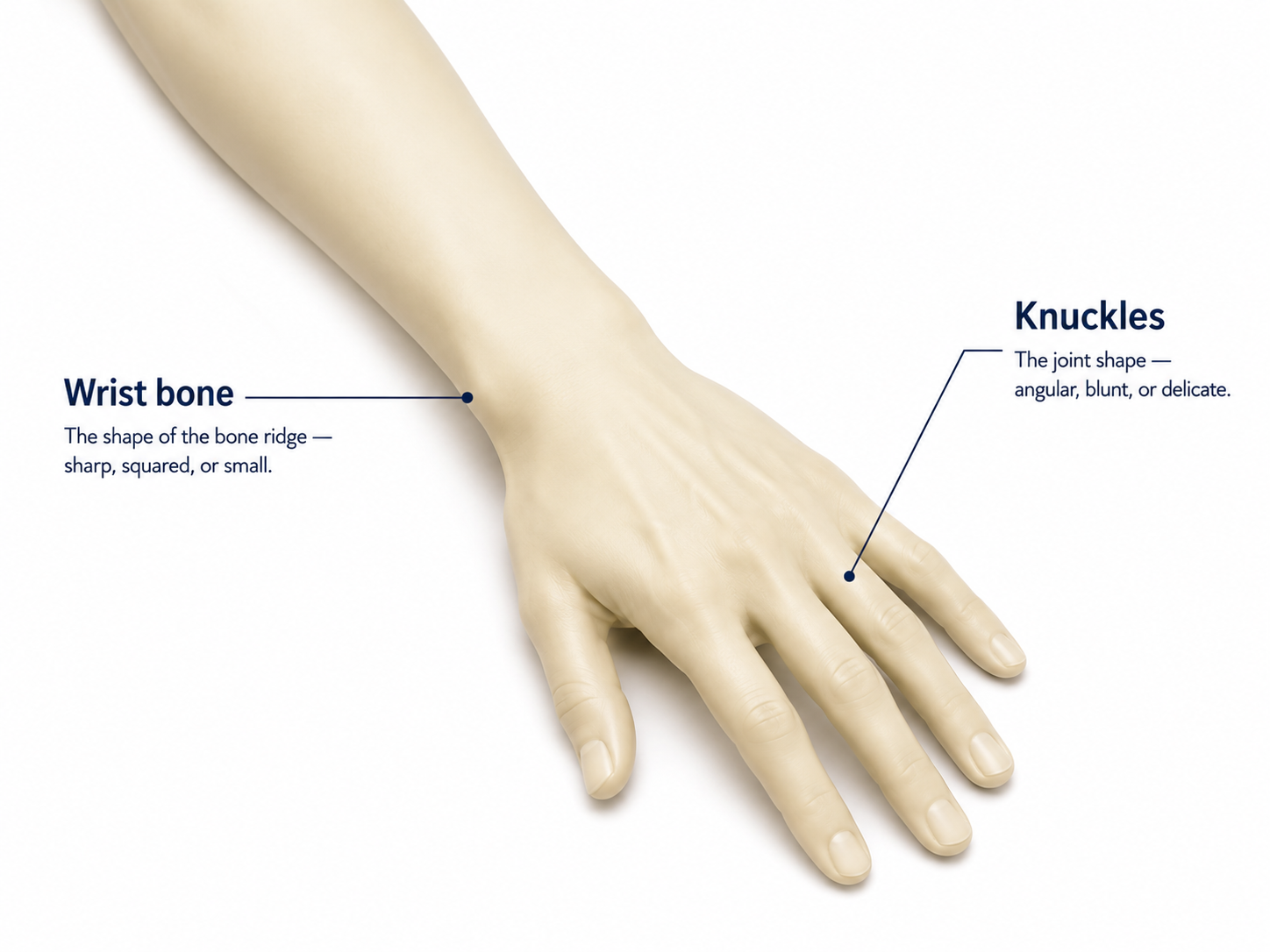
Palm down, look at the wrist joint and the back of the hand together — read the bone shape, not the circumference. A knife-thin ridge with long fingers reads sharp yang (Dramatic). A squared, substantial joint with a wide palm reads broad yang (Natural). A small, fleshed-over joint with short fingers reads delicate yin (Romantic, Soft Gamine).
Common traps
- Confusing flesh with bone
A heavier woman with delicate bones is still small-boned, and might still read Romantic. A lean woman with squared shoulders is still broad-boned, and probably reads Natural.
- Confusing height with bone size
A short woman with long, narrow bones can read tall. A taller woman with broken proportions can read short.
- Misreading 'broad'
Broad means actually wider than the rest of your frame — your upper back is the widest part of your torso, and clothing has to accommodate it. Sharp shoulders that end in a square corner but sit narrow on the body are not broad. They're sharp.
- Aspirational typing
Dramatic sounds chic, Soft Dramatic sounds glamorous, Flamboyant Gamine sounds cool. Self-typers re-read their own bones until the verdict matches the type they wanted.
The takeaway: your bones aren't a score sheet, they're a frame. They set the floor and ceiling of what your clothes can do — what they have to accommodate, what they can elongate, what they have to soften.
I may earn a commission through some affiliate links in this module. Please consider using them — they keep the core StyleMeMama tools free and help cover ongoing costs.