Width gives you shape. Height gives you proportion.
Body shape tells you the silhouette you draw across. Vertical proportion tells you how that silhouette stacks top-to-bottom — where your torso splits against your legs, where your waist sits, where your shoulders ride above your hips, and how all of that runs against your overall height. It's the read that decides whether a pant rise feels right, whether a hem looks intentional or accidental, and whether a jacket length finishes your line or stunts it. Two people with the same shape can dress on opposite rules, and proportion is usually why.
The vertical thirds
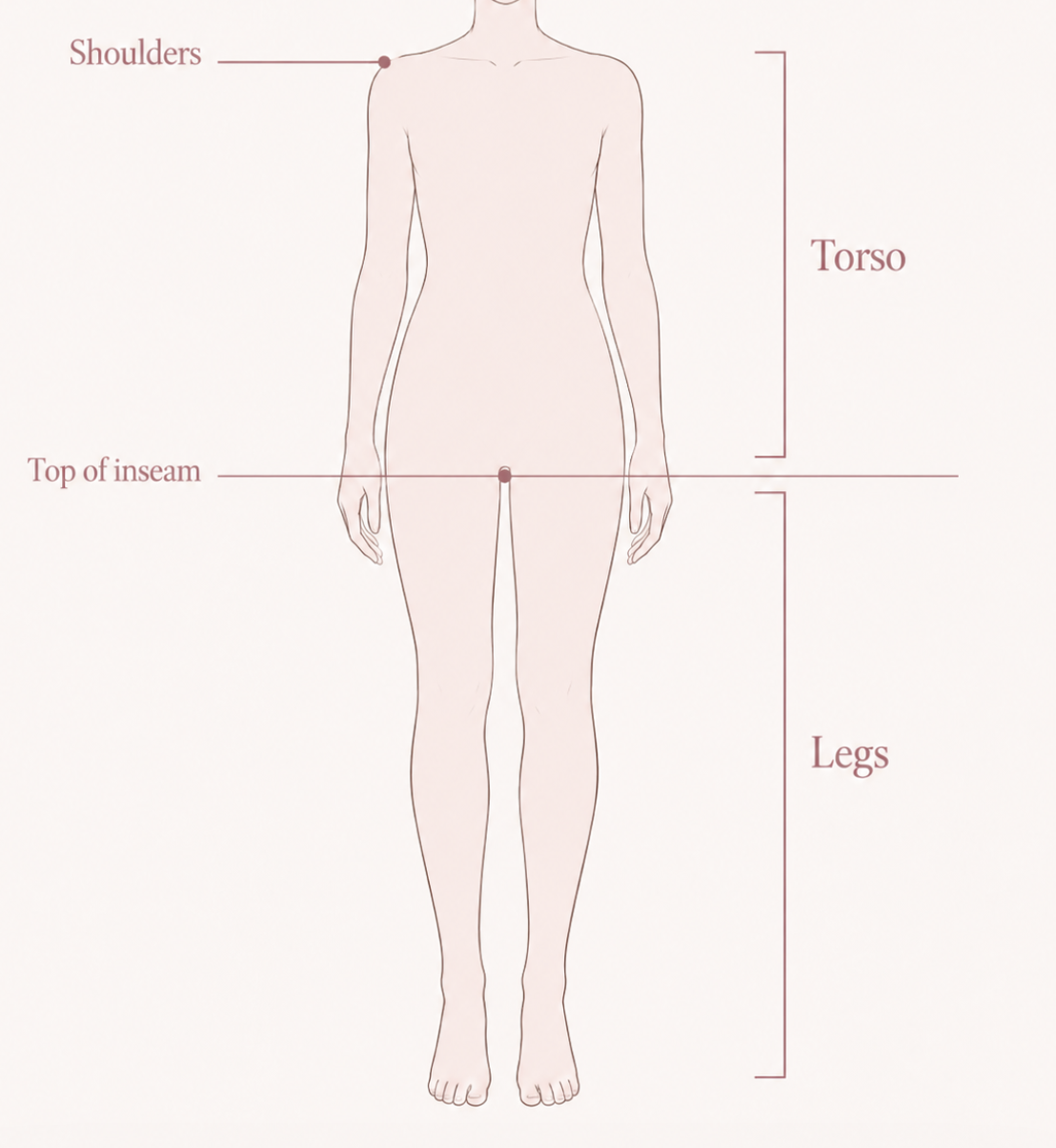
The cleanest way to think about height proportion is to split your body at two horizontal lines: the shoulders, and the top of the inseam. The span above is your ; from there to the floor is your legs. Whichever measures longer is the half that sets your proportion.
Where your natural waist falls
Your — the narrowest point of your — has its own height, separate from how long your torso is overall. A long torso can carry a high-set waist; a short torso can carry a low-set one. This is the read that drives rise: the classic "high-rise rolls down and mid-rise sits weird" complaint is almost always a low-set natural waist trying to wear a pattern drafted for a high-set one.
Where hems should hit you
Hem length is the place vertical proportion meets the rack. A "midi" on a 5'10" model can hit you mid-calf or just below the knee depending on your torso-to-leg ratio. A shorter torso (longer legs) handles midi and maxi hems beautifully; a longer torso (shorter legs) usually does best in minis or knee-length pieces, where the cutoff doesn't divide the leg in half.
Pant silhouettes and the vertical line
Pant cut decides where the leg breaks and how long the line reads. Length and rise stack on top of cut: a high-rise wide-leg adds visual height; a low-rise cropped skinny does the opposite.
Outerwear and your line
Outerwear is the layer that finalizes your silhouette. Its length, where it cinches, and where it ends decide whether the rest of the outfit reads tall, balanced, or stunted.
Shop by height when you can
Petite, regular, and tall lines exist because most brands grade inseam and rise off those height ranges, so starting there saves you most of the guesswork. The catch is that height doesn't actually tell you leg length. Two people both 5'2" can have inseams an inch or two apart depending on whether their length sits in the torso or the legs, and the same "petite" pant lands at the ankle on one and mid-calf on the other. Measure your inseam at least once and write it down; brand size charts go from approximate to useful the moment you have your own number to check against.
Petite
Under 5'4"The vertical line is short before the clothes touch it. Anything that breaks the line at the knee, or pools at the ankle, will shorten the read further. Cuts graded for a shorter inseam keep the proportions the pattern intended.
Average
5'4" – 5'8"The vertical line is what most brand patterns are drawn against. Inseams, sleeves, and hems usually land where the lookbook photo suggests, which is why standard size charts feel like they work here.
Tall
Over 5'8"The vertical line is long, and standard cuts often end an inch or two too early. Tall-line grading and intentionally long hems let the line read finished instead of cut off mid-shin.
I may earn a commission through some affiliate links in this module. Please consider using them — they keep the core StyleMeMama tools free and help cover ongoing costs.